
Atlas Lifestyle Automated Warranty Checks and Repair Triage for Every Request
How Singapore's Herman Miller specialist opened its repair service to all Aeron owners, including chairs it never sold, using Dyrect's structured repair intake and 12-year warranty validation.
"A lot of the Aerons in Singapore didn't come from us. That doesn't matter to us. If we're the ones who fix it, we're the ones they come back to. The intake is what lets us say yes to all of them without drowning."
Introduction
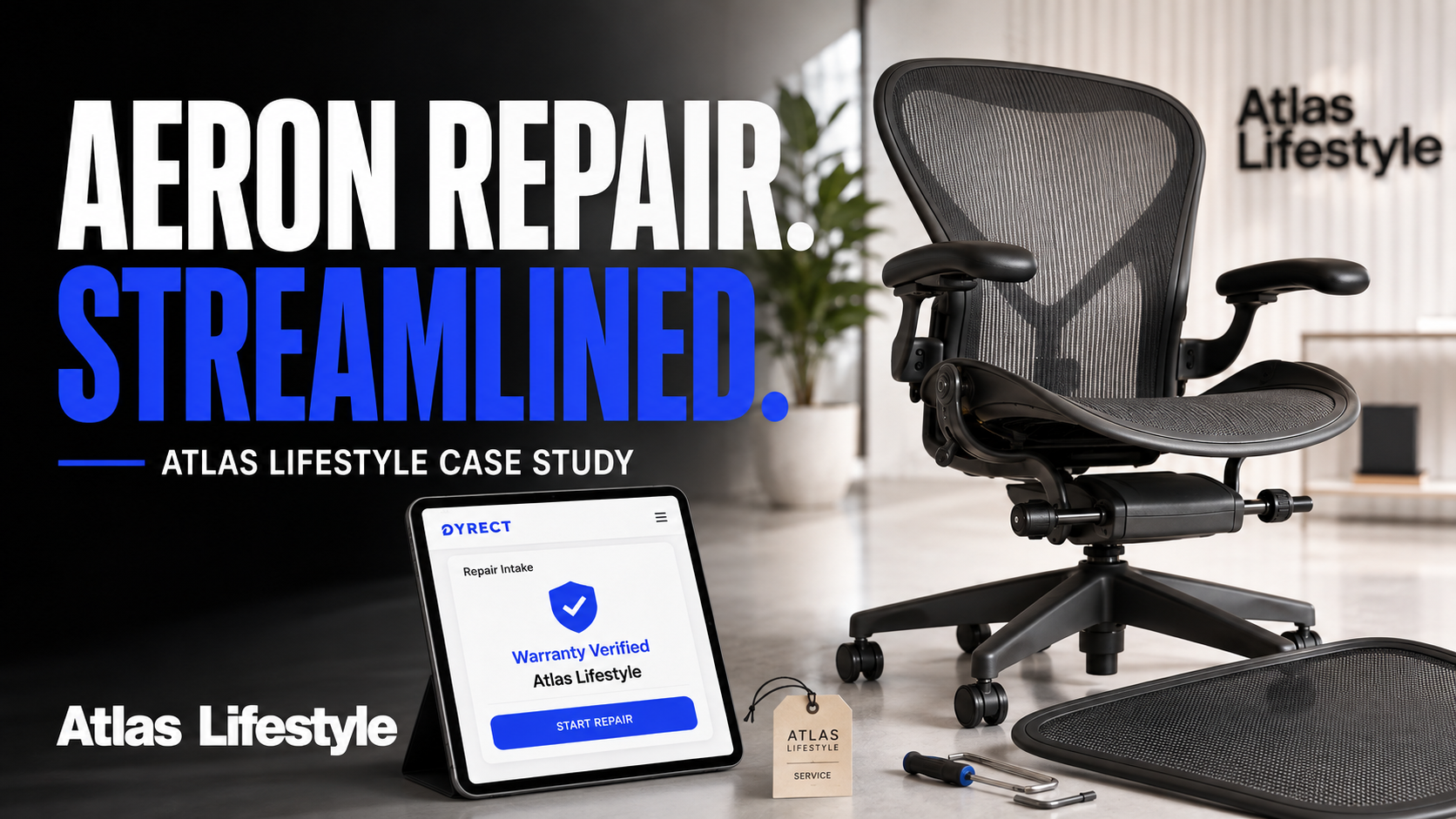
Most retailers only service chairs they sold. Atlas Lifestyle services every Herman Miller Aeron in Singapore, regardless of where the owner purchased it.
That decision is deliberate. The Aeron carries a 12-year warranty. Owners keep the chair for a decade or more. The population of people who need a repair at any given time is far larger than the population who bought from Atlas recently. And the most common issue (torn or ripped mesh) is specifically excluded from warranty coverage and quoted as a paid repair.
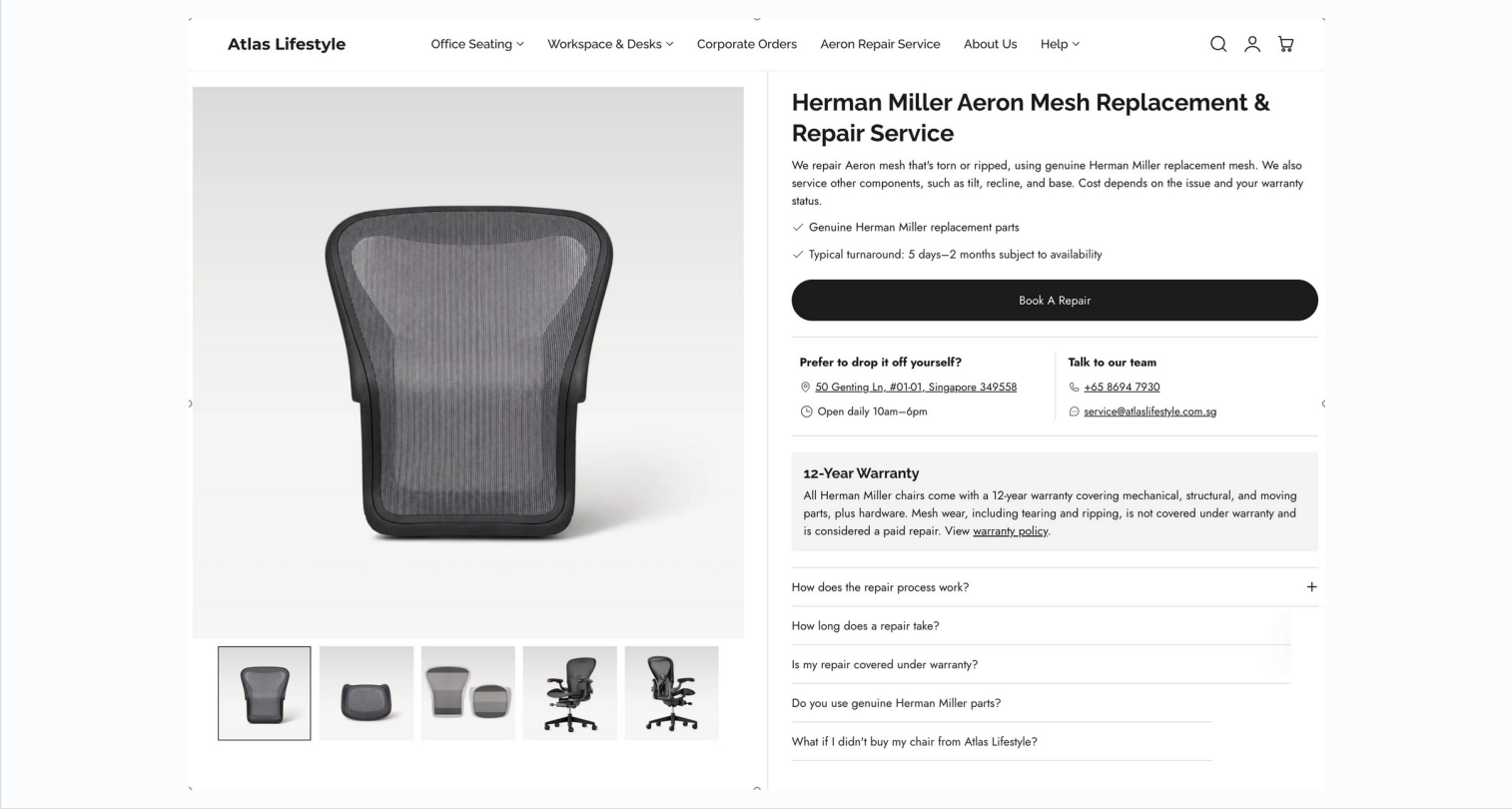
Atlas saw an opportunity most retailers overlook: every Aeron owner in Singapore is a potential customer, whether Atlas sold them the chair or not. "Aeron Repair Service" sits in the main navigation on atlaslifestyle.com.sg alongside the product categories. The repair itself is merchandised as a product with its own page, images, FAQs, and a "Book A Repair" CTA.
But promising repair to everyone is easy. Operating it at scale without drowning in unstructured WhatsApp messages and email threads is the hard part.
Dyrect powers the structured intake and warranty validation that makes the promise operational. The repair request flow is live at atlaslifestyle.dyrect.co.
About Atlas Lifestyle
Atlas Lifestyle is a Singapore retailer focused entirely on one brand: Herman Miller.
The catalogue covers the full Herman Miller seating range (Aeron, Embody, Sayl, Cosm, Setu, Mirra 2, Verus) alongside desks, monitor arms, and corporate orders. The business has served more than 51,600 customers in Singapore and holds a 4.8 out of 5 rating across public reviews.
Atlas also operates an in-house repair facility at 50 Genting Lane, Singapore, open daily 10am to 6pm. The team uses genuine Herman Miller replacement parts and handles both warranty-covered repairs and paid services like mesh replacement.
The repair operation is not a side function. It is a revenue-generating service line and a customer acquisition channel, positioned alongside new chair sales in the site's navigation and merchandising.
Challenges Atlas Lifestyle Faced Before Dyrect
Atlas had already made the strategic decision to open repair to every Aeron owner. The problem was operational: the intake process could not keep up with that ambition.
Repair requests arrived in no fixed shape. WhatsApp photos, email descriptions, and phone calls all fed the same service team. There was no common structure across channels and no single queue. The team reconciled three inboxes manually.
Warranty-covered and paid work had to be untangled by hand. Tilt, recline, and base faults may fall under Herman Miller's 12-year warranty. Mesh wear never does. Figuring out which category a request fell into required a conversation, sometimes multiple, before the team could even quote the job.
Owners could not identify their own chair. Aeron generations, sizes, and configurations differ. Someone who has owned a chair for eight years rarely knows whether they have a Classic, a Remastered, a Size B or a Size C. The service team received descriptions like "my Herman Miller chair" and had to work backwards from photos.
Evidence had to be chased after the first reply. Assessment requires clear photos and video of the defect. But the initial request rarely included them. Asking for evidence after the first reply pushed the real response back by days.
Non-customers were the hardest cases to process. Owners who purchased from a different retailer (or secondhand) had no order record and no purchase date on file with Atlas. These were the requests that most needed structure and arrived with the least data attached.
The intake did not match the storefront. Atlas merchandised repair properly on atlaslifestyle.com.sg with dedicated navigation placement, a product page, images, and FAQs. But the actual form behind it was the weakest part of the experience. The promise was premium; the process was not.
The core issue: every ambiguity that a human had to resolve was a delay the customer felt and an hour the service team spent sorting rather than repairing.
What Dyrect Delivered for Atlas Lifestyle
Two Dyrect modules are live at Atlas Lifestyle: a branded repair request intake and warranty validation sitting behind it. Together, they take an enquiry from whoever sends it (long-standing customer or complete stranger) and structure it into an already-classified case before a single person on the Atlas team reads it.
1. Branded Repair Request Flow on Atlas's Domain
The repair page on atlaslifestyle.com.sg/pages/chair-repair-service hands off to a guided intake flow on atlaslifestyle.dyrect.co.
The flow is headed "Tell Us About Your Chair" with a progress bar showing the customer how far they have to go. It reads as part of the Atlas experience, not as a third-party form bolted on at the end.
Above the form, the repair page states clearly: "Whether you purchased from us or not, we are here to help. Submit your details below and our team will get back to you within 1 business day."
That line is the business model in one sentence. The intake flow beneath it is what makes the promise scalable.
2. Guided Product Selection via Searchable Catalogue
The first step in the flow asks the customer to identify their chair through a searchable product picker, not a free-text box.
The customer types a product name and selects it from Atlas's catalogue. They do not need to know their Aeron generation, size, or configuration. The catalogue handles the disambiguation: Atlas maintains the product list once, and every incoming request arrives mapped to a real SKU.
This solves two problems at once. Customers who don't know what they own get guided through identification. And the service team never receives "my Herman Miller chair" as a product description. Identification happens once, correctly, at the front of the process.
3. Structured Evidence Capture in the Original Submission
Atlas's published repair policy requires photos and videos of the defect before assessment can begin. The Dyrect intake collects all of this inside the original submission, not as a follow-up request.
A photograph of a torn mesh panel or a video of a failing tilt mechanism tells the assessor more in five seconds than three emails of back-and-forth description. And the evidence arrives attached to the correct chair, not floating in an inbox thread.
Because evidence is captured upfront, the first reply the customer receives is a real answer (a quote, a coverage confirmation, or a next step), not a request for more information.
4. Warranty Validation Against Herman Miller's 12-Year Policy
Behind the form, each request is automatically checked against the Herman Miller warranty terms that Atlas publishes on its site:
- Mechanical, structural, and moving-part failures may be covered under the 12-year warranty
- Mesh wear (tears and rips) is specifically excluded and quoted as a paid repair
Every incoming request can have one of three outcomes: warranty-covered work, chargeable repair, or a paid quote for someone who purchased elsewhere. These three categories are separated as the request lands, not after a conversation.
For the service team, the question changes from "is this job covered?" to "what does it cost and when can we schedule it?" That is a fundamentally shorter job.
Before and After
Request format: Previously, repair enquiries arrived by WhatsApp, email, and phone in no fixed shape. Now, one structured intake on atlaslifestyle.dyrect.co produces the same complete case format every time.
Chair identification: Previously, owners had to figure out which Aeron generation and size they had. Now, a searchable product picker handles identification. The customer types a name and selects from the catalogue.
Evidence collection: Previously, photos and video were requested after the first reply, adding days to the process. Now, evidence is captured inside the original request, before assessment begins.
Warranty sorting: Previously, warranty-covered and chargeable work were separated by hand, case by case, often requiring multiple conversations. Now, requests are validated against the 12-year policy automatically as they arrive.
Non-customer requests: Previously, people who purchased elsewhere were the hardest cases to process because they had no order record on file. Now, non-customer requests come through the same structured flow, ready to quote.
Response time: Previously, the first response depended on what the team could piece together from scattered messages. Now, the team opens a complete case with product, fault, and evidence attached, and can hold its published one-business-day commitment.
Outcome
Atlas Lifestyle now runs its full repair intake and warranty validation on Dyrect.
What is live today:
- Structured repair intake at atlaslifestyle.dyrect.co, open to every Aeron owner in Singapore
- Guided product selection via searchable catalogue, eliminating free-text chair descriptions
- Upfront evidence capture with photo and video collected in the original submission
- Automatic warranty validation against Herman Miller's 12-year policy on every request
- Three-way case classification at intake: warranty-covered, chargeable repair, or paid quote for non-customers
- One-business-day response commitment published on the repair page and enforced by the system
What changed operationally: Every request opens as a complete case. Product, fault, and evidence are attached before anyone reads it. The team quotes jobs rather than investigating whether they are covered. Three separate channels (WhatsApp, email, phone) collapsed into one structured queue.
What changed for customers: Owners do not need to know their chair's generation or configuration. One submission collects everything. The first reply is substantive. And people who purchased their Aeron from a different retailer (or secondhand) get a real path in, not an exception the team works around.
What changed strategically:
Repair is now a customer acquisition channel. Every Aeron owner in Singapore is reachable through the repair page, regardless of who sold the chair. A good repair is a strong first impression, and Atlas captures a first-party record of every owner who submits a request, including chairs Atlas never sold.
Mesh replacement is a revenue line. It is merchandised as a paid service alongside new chairs on atlaslifestyle.com.sg, with its own navigation slot, product page, images, pricing context, and FAQs. The intake flow feeds directly into this revenue stream.
The addressable market expanded beyond Atlas's own order book. The installed base of Aerons in Singapore that Atlas can now serve and market to is larger than the base it originally sold. Every repair request from a non-customer is a new relationship Atlas owns.
The brand promise is enforced by the system, not by individual effort. Genuine Herman Miller parts, the published 12-year warranty terms, and the one-business-day response commitment are all held up by the intake structure rather than depending on the team remembering to check each one.
Final Takeaway
Atlas Lifestyle made a strategic decision that most retailers avoid: open the repair desk to everyone, including owners of chairs the business never sold.
Dyrect made that decision operational. Two modules (structured repair intake and warranty validation) ensure that every request, from a loyal customer or a complete stranger, arrives as a complete, already-classified case. The team quotes instead of investigating. Customers submit once instead of going back and forth. And every Aeron owner who walks through the repair flow becomes a first-party contact Atlas can serve again.
Atlas now has a first-party record of Herman Miller chairs across Singapore that extends far beyond its own sales history, and every repair request is an opportunity to earn a customer for life.