Claims Management
How NUUK Cut Warranty Resolution Time by 50% Across 6 Product Categories
From scattered spreadsheets and manual ticket handling to a single platform that manages product registration, warranty claims, repair routing, replacement logistics, refunds, and customer communication for every appliance NUUK sells.
"Dyrect gave us a single system to manage everything that happens after a customer buys a NUUK product. Registration, warranty, claims, repairs, replacements, refunds, and communication. All in one place, connected to the tools we already use."
At a Glance
What Changed After Dyrect
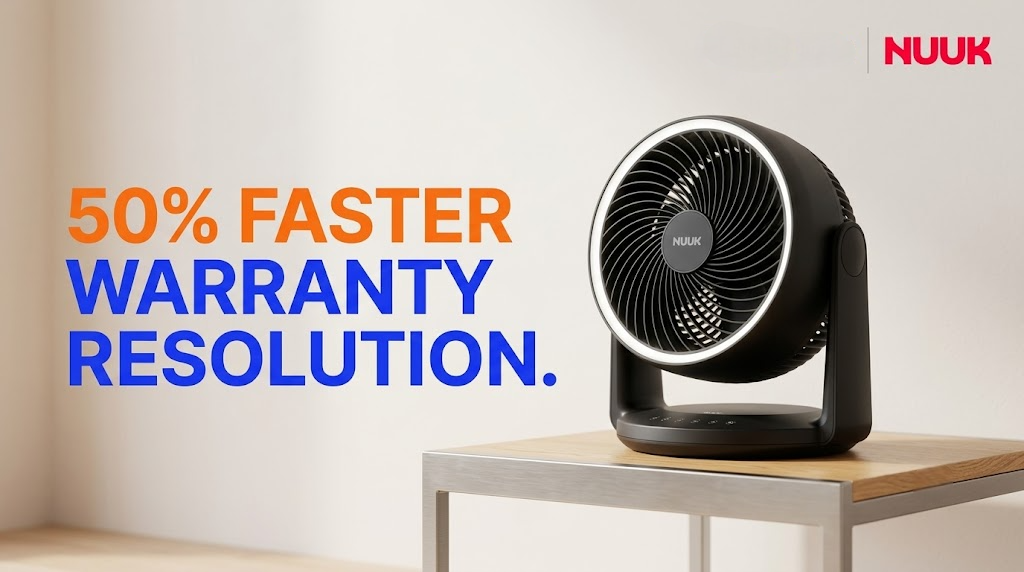
- 50% faster warranty claims resolution
- 3x increase in warranty registration attachment rate
- 10x more post-purchase customer engagement
- Zero manual ticket routing. Every claim auto-assigned based on product category and issue type.
About NUUK
NUUK is a design-first home appliance brand based in Gurugram, India. The brand sells across six product categories: fans (air circulators, hand fans, desk fans, clip fans, folding fans), kitchen essentials (air fryers, cold press juicers, mixer grinders), vacuum cleaners (cord-free, portable, mattress), garment care (steamers, lint removers), and heaters (oil-filled radiators, PTC space heaters).
NUUK sells primarily through its own Shopify store (nuuk.in) and through offline retail. The brand has reached over 400,000 homes and is known for combining premium industrial design with practical features like mood lighting on fans, ILAG-certified ceramic coatings on air fryers, and adaptive suction on vacuum cleaners.
The brand is positioned as a premium alternative to legacy appliance companies. That positioning creates a specific expectation: when something goes wrong with a product, the after-sales experience needs to match the quality of the product itself. Before Dyrect, it did not.
The Problem
NUUK's after-sales operation had five specific problems that were getting worse as the product line grew.
Problem 1: No Unified System Across Product Categories
NUUK sells fans, air fryers, vacuum cleaners, steamers, heaters, and accessories. Each category has different failure modes, different parts, and different resolution paths. A fan motor issue is not the same as an air fryer heating element failure. But NUUK was handling all of these through the same unstructured process: customer emails, manual spreadsheets, and phone calls.
What this caused: Tickets for different product categories were handled inconsistently. Some got resolved quickly because the team knew the product well. Others sat in queues because the right person was not assigned.
Problem 2: No Automatic Product Identification
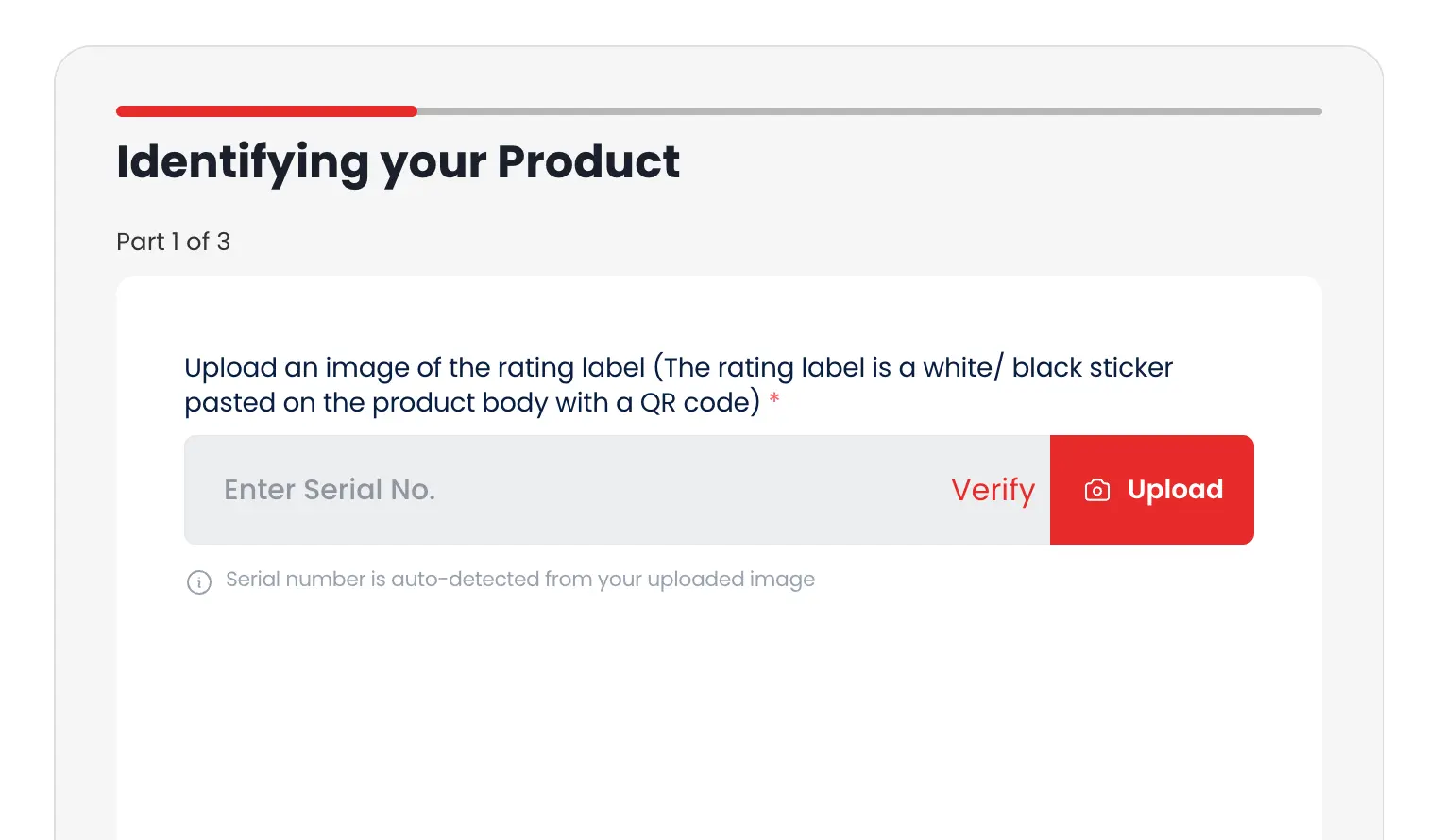
When a customer reported an issue, the support team had to manually figure out which product the customer owned, when it was purchased, and whether it was still under warranty. This required back-and-forth messages asking for invoice copies and serial numbers.
What this caused: Resolution time increased by days just to establish basic facts. Customers had to dig through old emails to find purchase receipts, leading to frustration before the actual issue was even addressed.
Problem 3: No Structured Claim Validation
There was no quality control step between a customer reporting an issue and the company committing to a repair, replacement, or refund. Every claim was taken at face value and routed to logistics.
What this caused: Unnecessary repairs and replacements on claims that could have been resolved with troubleshooting guidance. Wasted logistics spend. No way to detect patterns in false or misdiagnosed claims.
Problem 4: Disconnected Logistics
Pickup, repair, and dispatch were coordinated manually. When a product needed to be picked up from a customer, sent to a repair center, and shipped back, each step was tracked separately. Nobody had a single view of where a unit was in the process.
What this caused: Customers had no visibility into when their product would be picked up or returned. Internal teams could not tell whether a unit was in transit, in repair, or waiting for parts. Follow-up calls from customers added to the support team's workload.
Problem 5: No Proactive Warranty Registration
NUUK had no system to encourage customers to register their products after purchase. The only time the brand heard from a customer was when something went wrong. There was no extended warranty offering and no way to build a relationship between the point of sale and the point of failure.
What this caused: NUUK had no first-party database of product owners. No way to send proactive maintenance tips, recall notices, or upsell extended coverage. Every customer interaction started from scratch.
The Solution: What Dyrect Built for NUUK
Dyrect replaced NUUK's fragmented after-sales process with a single platform covering everything from the moment a customer registers a product to the moment a resolved ticket is closed. Here is exactly how it works, step by step.
Module 1: Product Registration and Extended Warranty
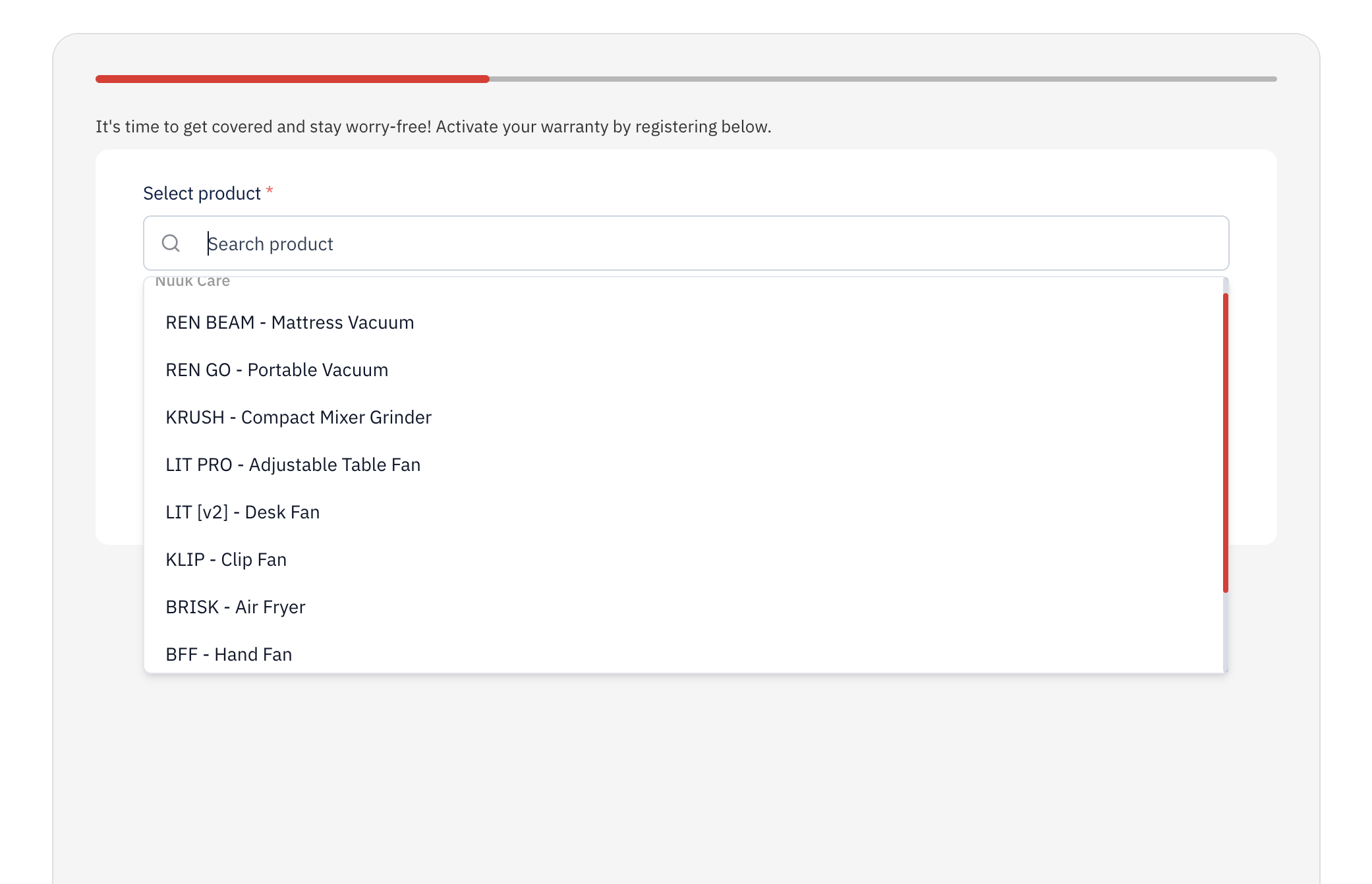
How customers enter the system:
There are two ways a NUUK customer enters the Dyrect-powered system. Both lead to the same unified backend.
Path A: Rating Label Scan (for customers with an issue)
Every NUUK product has a rating label (a white or black sticker on the product body with a QR code). When a customer scans this QR code with their phone camera, the system automatically:
- Detects the serial number from the scan
- Identifies the exact product (model, category, variant)
- Validates whether the product is still under warranty
- Drops the customer into a guided claim submission form
The customer does not need to type in any serial number, look up any model name, or provide proof of purchase (unless they bought from a channel other than nuuk.in). The scan does it all.
- This is live today at: warranty.nuuk.in/user/forms/support_request
- What the customer is asked for: Rating label photo, invoice (only if not purchased from nuuk.in), and photos or videos showing the issue.
Path B: Catalogue Search (for customers without an issue)
Customers who want to register their product for warranty coverage or unlock extended product care go to a separate page. There, they search NUUK's product catalogue, find their product, and register it.
- This is live today at: warranty.nuuk.in/user/forms/web_registration
- What the customer gets: Confirmed warranty registration, access to extended product care options, and a direct line to NUUK's support system if an issue arises later.
Why this matters: Before Dyrect, NUUK only heard from customers when something broke. Now, NUUK captures customer data at the point of registration (often days or weeks after purchase), building a first-party database of product owners that the brand can communicate with proactively.
Module 2: Warranty Claim Submission and Ticket Routing
When a customer submits a claim through Path A (the rating label scan), the system does not just log the request. It creates a structured ticket and routes it automatically.
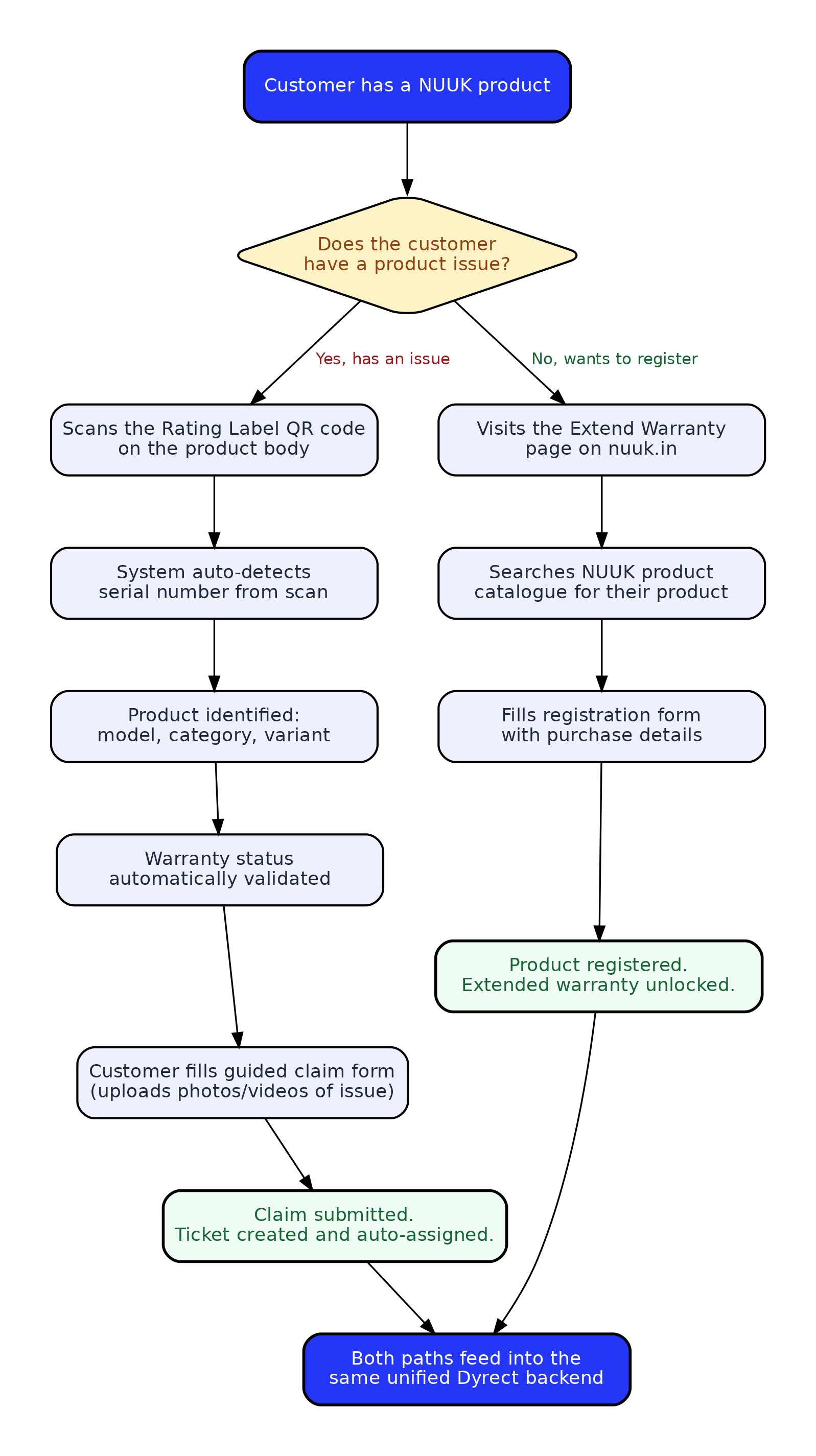
Key point: No manual triage. No one at NUUK has to read the ticket and decide who should handle it. The system routes it based on rules: product category, issue type, warranty status, and customer location.
Module 3: Issue Validation and Quality Control
This is the step most warranty systems skip, and the one that protects NUUK's margin.
Before any logistics spend is triggered (pickup, repair parts, replacement unit, refund), every claim goes through a QC validation stage. A trained team member reviews the customer's submitted evidence (photos, videos, description) and makes a call:
QC Decision Outcomes:
Why this matters: Without this gate, every claim would trigger logistics and parts spend. The QC step catches misdiagnosed issues (a customer thinks the motor is broken, but the power adapter is the problem) and prevents unnecessary cost. It also builds a data trail that helps NUUK identify recurring product issues for R&D.
Module 4: Logistics Decision Matrix
Once a claim passes QC, the system determines which logistics path to follow. This is not a single "send a courier" step. NUUK's resolution paths require different logistics choreography depending on the situation.
The five logistics variants:
Why this matters: Most after-sales platforms treat logistics as a single step. NUUK's product range (small accessories to large appliances) and resolution types (repair vs. replace vs. refund) require different flows. The decision matrix ensures the right logistics path is selected automatically based on the QC outcome and product type.
Module 5: Repair, Replacement, and Refund Workflows
Each resolution type has its own structured workflow running on Dyrect.
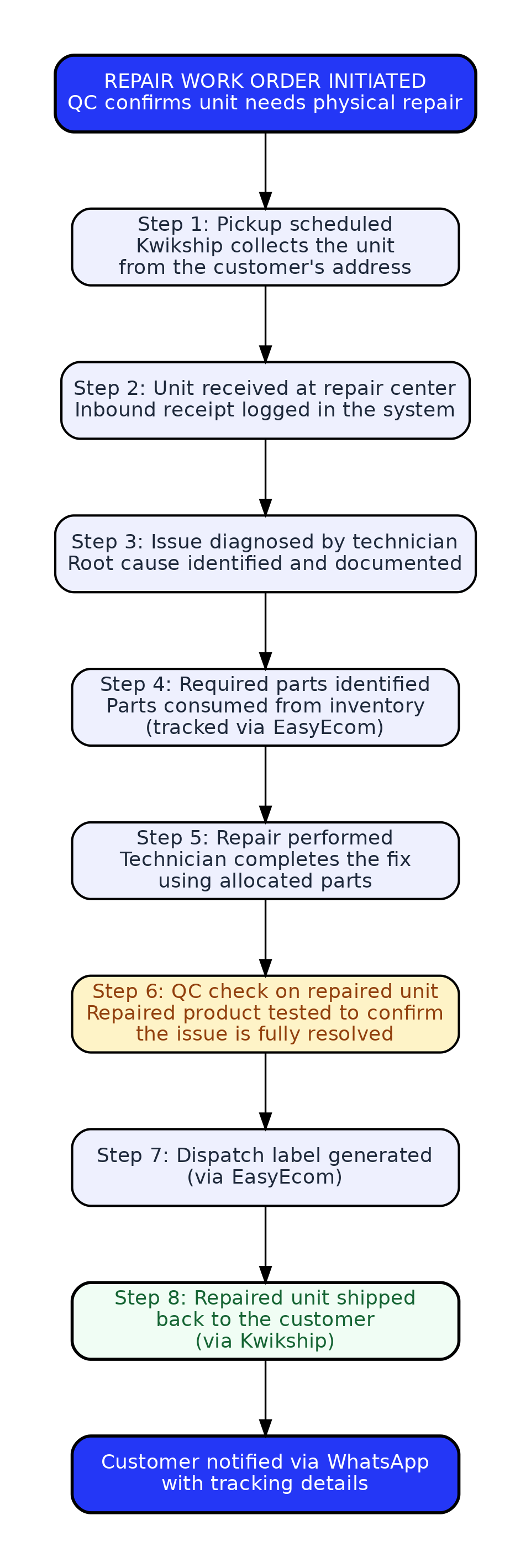
Repair Workflow:
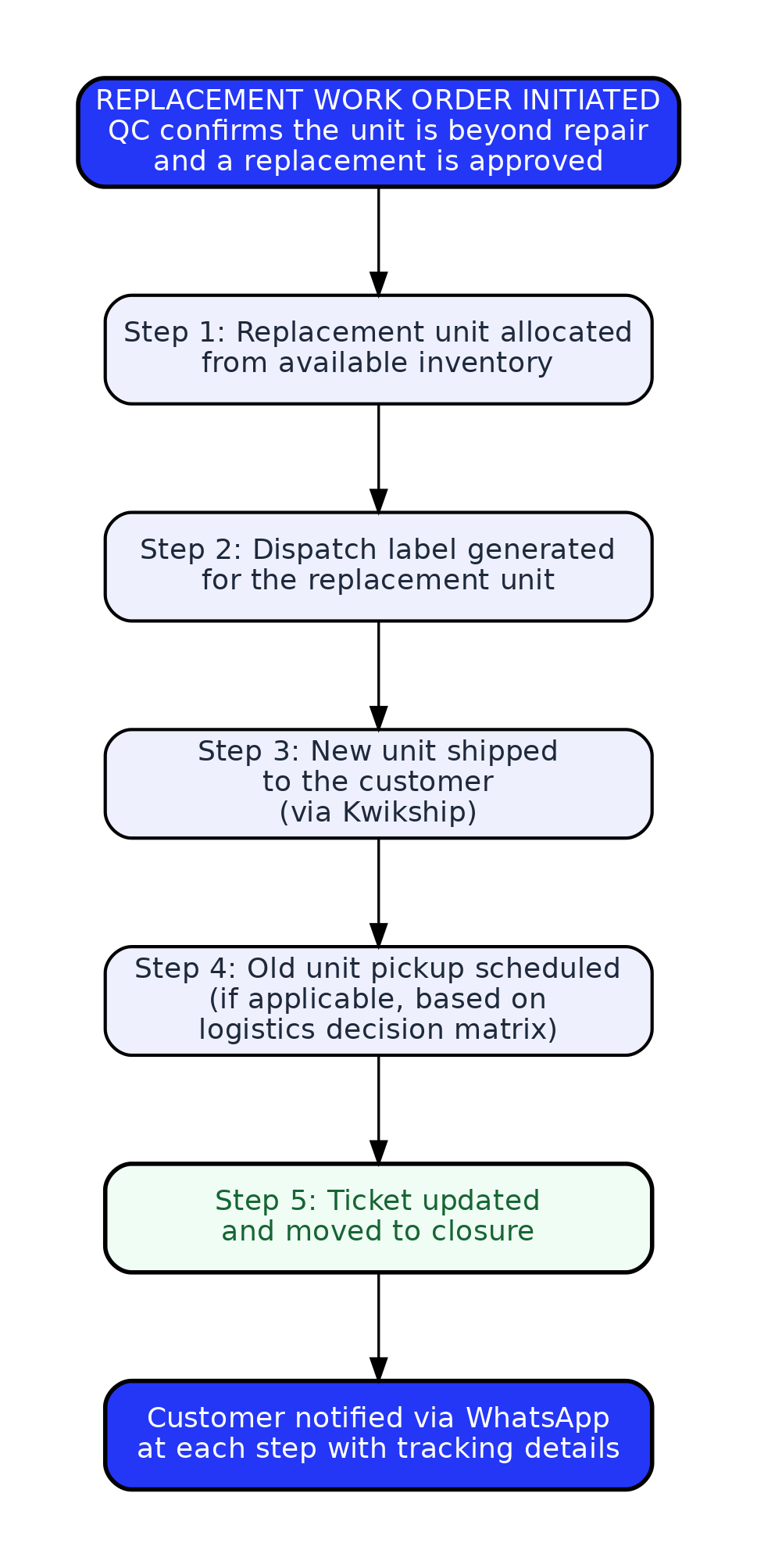
Replacement Work Order Flow (5 steps):
Refund Workflow:
Refunds are triggered when the product cannot be repaired, a replacement is not available, or the claim qualifies for a refund under NUUK's policy. Two refund types are supported:
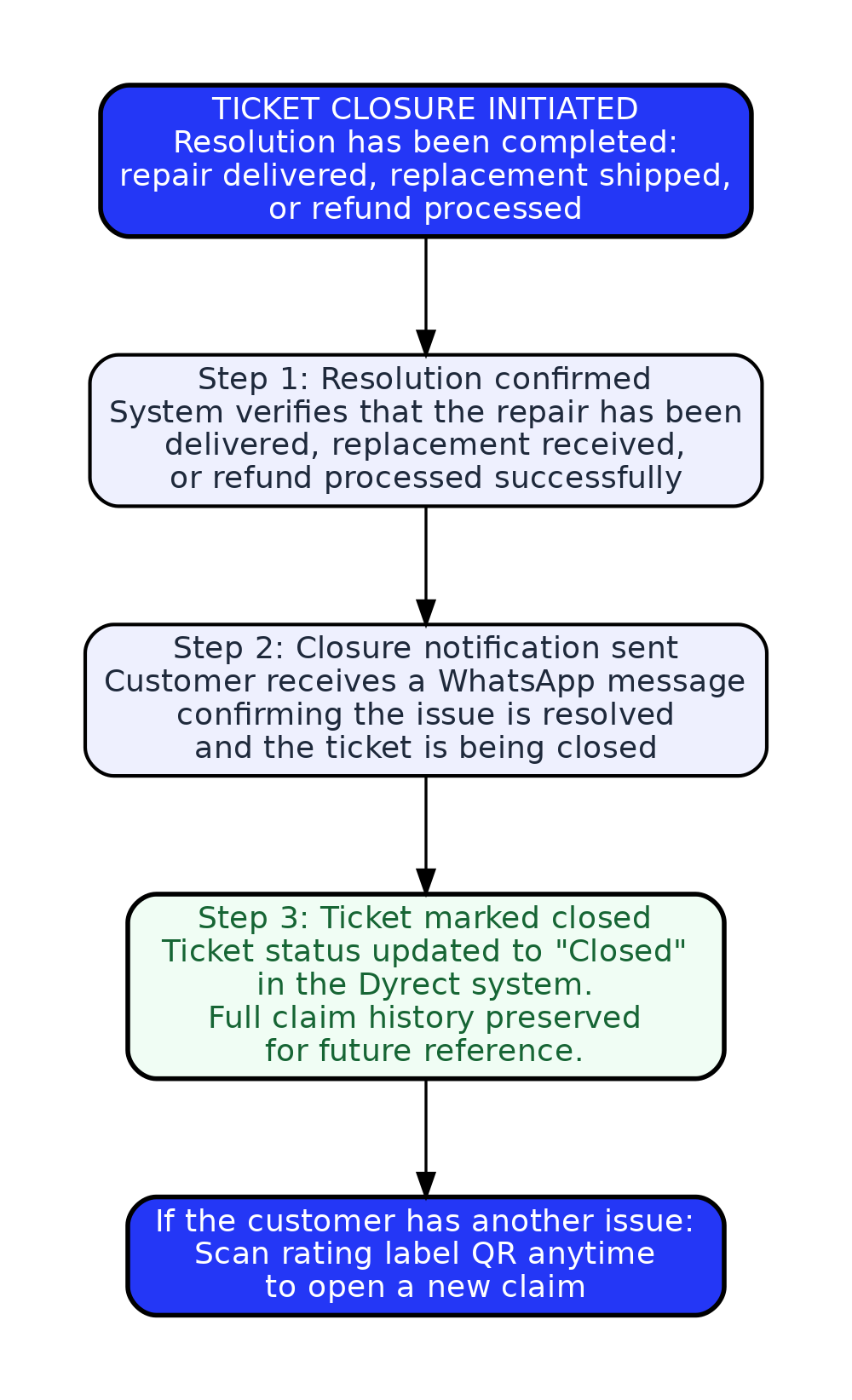
Ticket Closure (3 steps):
Module 6: Third-Party Integrations
Dyrect does not try to replace the systems NUUK already uses for shipping, inventory, payments, and communication. It sits on top of them and orchestrates the workflow.
Why this matters for similar brands: If you already use Kwikship for shipping and EasyEcom for inventory, Dyrect plugs into your existing stack. You do not need to migrate to new logistics or inventory tools. The integrations mean the system works with your current operations, not alongside them.
Module 7: Real-Time Customer Communication via WhatsApp
Every status change in the claim lifecycle triggers an automatic WhatsApp message to the customer. This is not an add-on. It is built into the workflow.
Messages the customer receives automatically:
Why this matters: The number one complaint in after-sales is "I do not know what is happening with my claim." Automated WhatsApp updates eliminate follow-up calls and support tickets that exist only because the customer has no visibility.
Before and After
Results
Customer Experience
Warranty claims are resolved 50% faster. Customers know exactly what is happening at every stage through automated WhatsApp updates. Product registration takes seconds through a QR scan, and extended warranty is available to every registered owner.
Operational Efficiency
Zero manual ticket routing. QC validation prevents unnecessary logistics and parts spend. Five logistics variants ensure the right resolution path is selected every time. Integrations with Kwikship, EasyEcom, GoKwik, and WhatsApp mean the team works in one system, not five.
Strategic Value
NUUK now has a growing first-party database of product owners across all six categories. Claim data feeds back to product and R&D teams, helping identify recurring issues by product line. Extended warranty drives additional revenue and deepens the customer relationship beyond the initial purchase.
Why This Matters for Brands Like NUUK
If you sell physical products across multiple categories, your after-sales complexity grows with every new product line. A fan has different failure modes than an air fryer. A vacuum cleaner needs different parts than a garment steamer. And customers expect the same quality of support regardless of which product they bought.
Most brands try to handle this with a combination of email inboxes, spreadsheets, and manual coordination. That works at 10 tickets a week. It breaks at 100.
What Dyrect built for NUUK is a system that scales with the product catalogue. Add a new category, configure the routing rules and parts inventory, and the same claim-to-resolution pipeline handles it. No new processes. No new tools. No new training.
The integrations (Kwikship, EasyEcom, GoKwik, WhatsApp) mean you do not need to rip out your current logistics or inventory stack. Dyrect connects to what you already have and adds the orchestration layer on top.
About Dyrect
Dyrect is the post-purchase experience platform for product brands. From warranty registration and claims management to loyalty programs and customer engagement, Dyrect helps brands own the customer relationship after the sale.
Platform-wide results across all Dyrect customers:
- 3x warranty registration attachment rate
- 50% faster claims resolution
- 10x increase in post-purchase engagement